

More homeowners now ask a question and get one answer back, from Google's AI summary, a voice assistant, or a tool like ChatGPT. We build your website so those tools can tell who you are, what you do, and where you work. No guaranteed placements.
A homeowner might type a search into Google, ask a voice assistant a question, or open ChatGPT and just ask. In all three, a computer is reading your website to decide whether to mention you.
They type a search into Google and scroll a list of results.
They ask a question, and Google or a voice assistant pulls one direct answer.
They open an AI tool and ask, with no search results page involved at all.
Most contractor websites were written to look good to a person skimming, not to be read closely by a machine. When the details are thin, an AI tool has nothing solid to work with, so it leans on whoever explained themselves better.
An AI tool does not know your business. It reads what it can find, then writes an answer in its own words. If your site never says clearly what you do and where, there is nothing for it to read.
Which businesses it names is up to the tool. Nobody can buy or guarantee a spot in that answer.
Someone asks a full question and gets one answer back instead of a list, from a voice assistant or the AI summary at the top of Google. Writing your pages so that answer can come from you is called answer engine optimization, or AEO.
What we don't promise: that an AI assistant or Google's AI Overview will choose your business as the answer. We don't control that, and no agency does. Read the full guide →
Someone opens an AI tool like ChatGPT and asks it to help them find a contractor. Keeping your business information clear and consistent enough for those tools to mention you is called generative engine optimization, or GEO.
What we don't promise: that ChatGPT, Gemini, or any AI tool will recommend your business by name. We do not control what a third-party AI model decides to generate, and neither does anyone else selling this service. Read the full guide →
Key pages open with a plain answer to the question the page is about, before any sales copy.
FAQ sections written as actual questions and answers, the way a homeowner would ask them.
Each real service gets its own page, so there is one clear place that explains it.
The cities and areas you cover, written out, not implied.
Schema.org markup that labels your business type, services, and questions for search systems.
The same business name, phone number, and service details everywhere they appear.
These are made-up questions to show the idea, not real searches or results.
Your site needs: a roof repair page that names leak repair and says, in words, that you work in Everett.
Your site needs: a question section that answers licensing, prep work, and warranty in your own words.
Your site needs: the same name, services, and service area everywhere, plus real reviews and project photos.
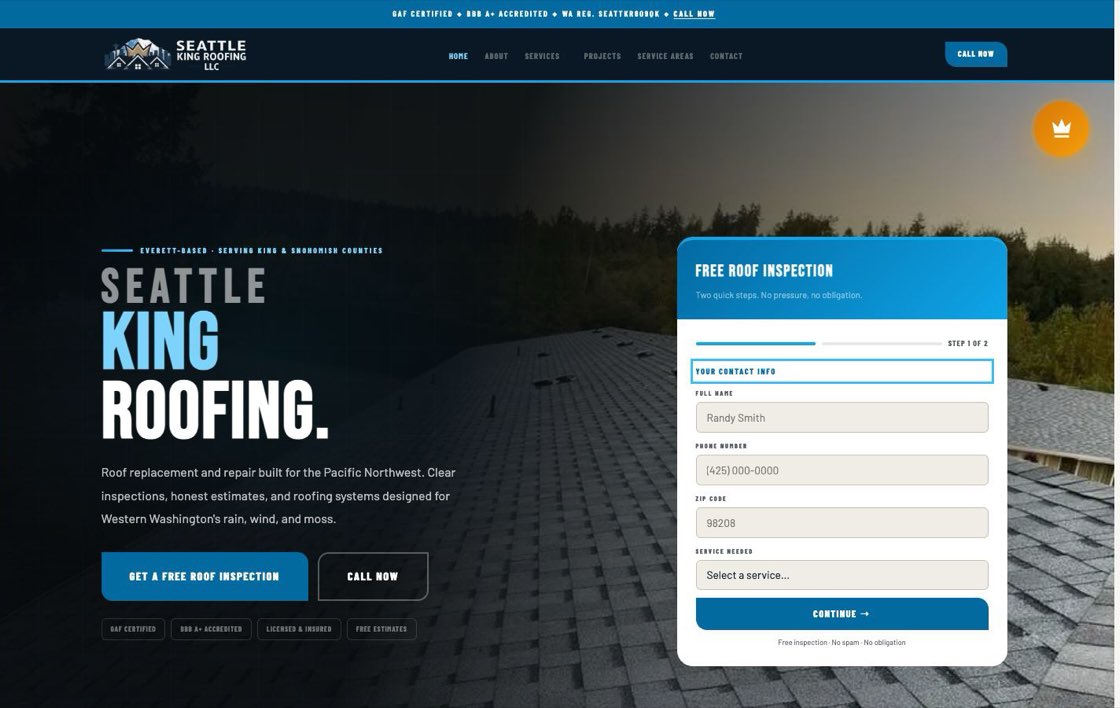
The site has a separate page for each of ten services, a section that states the areas served, and a questions section marked up with structured data so search systems can read each question and answer.
What we don't promise: that Google's AI summary, ChatGPT, Gemini, or any assistant will name your business. We do not control what a third-party tool writes, and neither does anyone else selling this.
See what a clear, well-structured site looks like for your trade and city.